Your prospects don’t read your emails. They certainly don’t read your AI-generated sequence that name-drops their alma mater before asking for “15 minutes to chat synergies.”
When you remove every ounce of human effort from outbound messaging, you destroy its signaling power. The result is an endless cascade of algorithmic sludge that every executive filters out with cold indifference. To break through the noise, you need radical friction.
My new, completely free eBook—Dinner-Led Growth: An In-Person Playbook Amidst a Sea of Slop—is available right now to show you how to turn intimate, theatrical executive dinners into your highest-converting pipeline channel. Grab your copy and learn how to replace canned pitch decks with two hours of immersive hospitality that buyers actually remember. Download it here.
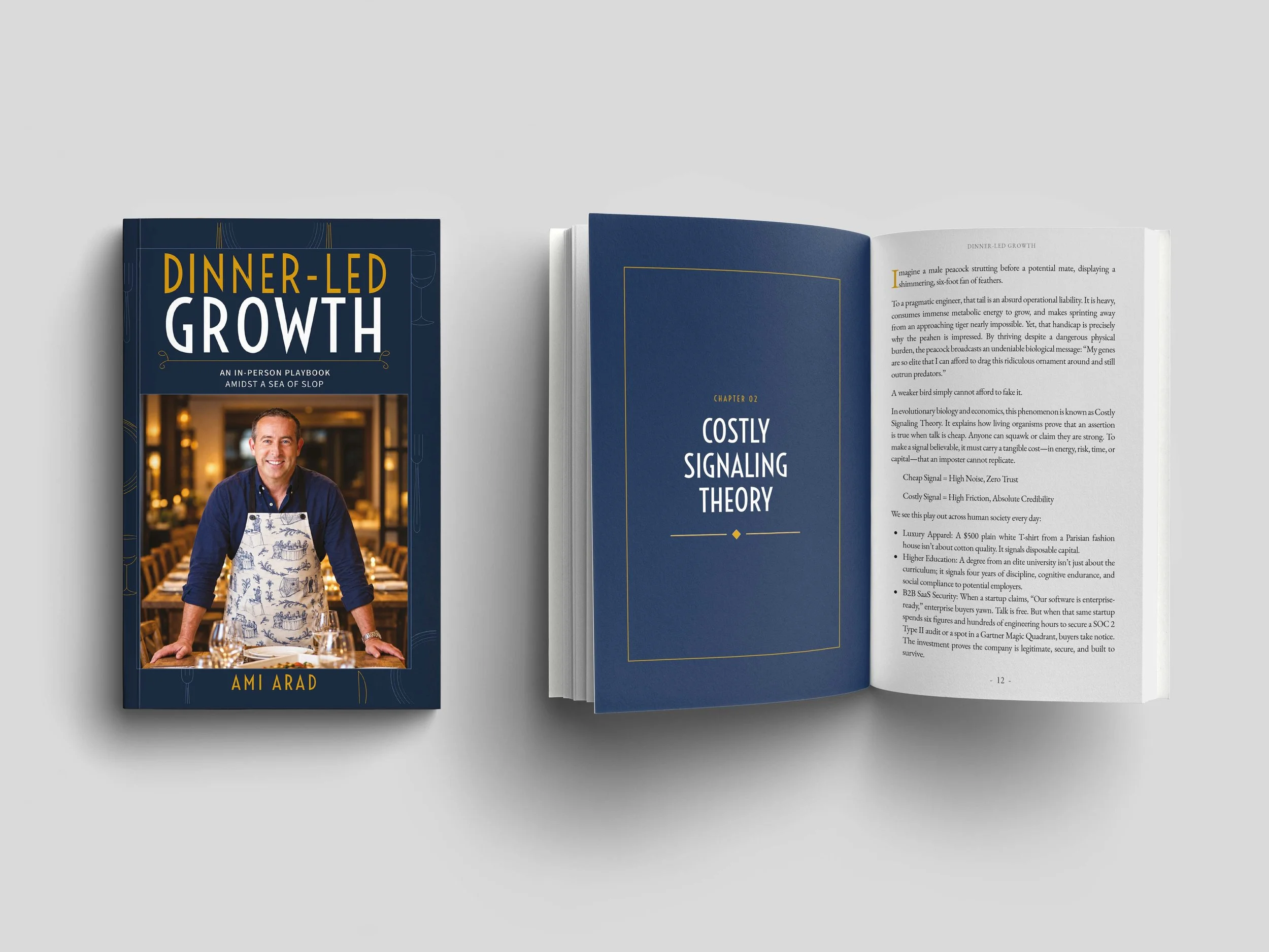
Here’s what’s inside:
Introduction: Why Most Executive Dinners Underachieve
The failure mode of treating executive dinners as standalone corporate events rather than a pipeline strategy.
The typical “mediocrity playbook”: generic steakhouses, recycled 30-slide pitch decks, half-hearted sales outreach, and half-empty dining rooms.
Differentiating high-stakes, scripted presentation-style dinners from casual networking or community dinners.
Chapter 1: Why Dinners?
The origin story: Going from a 0% response rate on 1,000 cold emails to generating outbound pipeline at Microsoft via Dinner by Dynamics.
Why a dinner invitation achieves 1–2 orders of magnitude higher response rates than digital outbound.
How declining invitees still open active sales conversations and pipeline.
The B2B Hospitality Matrix: Mapping customer touchpoints across experience intimacy and culinary quality.
Chapter 2: Costly Signaling Theory
The evolutionary biology principle behind executive attention (the biological peacock’s tail).
Why generative AI and zero-cost digital noise destroy the signaling value of email and automated outbound.
The outreach cost hierarchy: Comparing a $0.02 blast email to a $2.00 AE phone call and a $500/head executive dinner seat.
High-signal execution rules: Maintaining extreme scarcity (targeting 200–300 accounts for 12–15 seats), using AEs on the phone as the primary messengers, and leaning into real-world friction.
Chapter 3: Why Isn’t Sales Filling My Dinners?
Internal sales enablement: How to “sell the sellers” and educate reps on why an executive dinner is worth their time.
The 5-Part Selling Menu to equip sellers to pitch the table:
The Restaurant as a Signal: Choosing venues with stories, prestige, or Michelin accolades instead of the default local steakhouse.
The Experience: Ensuring the narrative is inseparable from the room rather than relying on a portable slide deck.
Real Executive Presence: Seeding the room with internal leadership rather than sending only quota-carrying AEs.
Peer-to-Peer Networking: Enforcing strict buyer title parity to attract senior peers.
True Scarcity: Restricting seat allocations by strategic sales segments to drive internal urgency.
Chapter 4: Table Stakes for Every Executive Dinner
The guiding thought experiment: "What would we do differently if we had to charge admission?"
Why booking a city's standard high-end steakhouse fails with local executives, and why spending 20–30% more on culinary destination venues pays off.
Meaningful interactivity vs. superficial audience participation (e.g., wine scent kits, Port tonging, Champagne sabering, invisible ink).
Intentional personalization: Handwritten calligraphy place cards and strategically assigned seating charts.
Incorporating company leadership and happy reference customers into the room.
The power of thoughtful, memorable souvenirs (e.g., personalized s'mores with attendee headshots, UV flashlights, cork display boxes) over corporate swag.
Chapter 5: Your Solutions Guide the Dinner
Using enterprise software processes (e.g., "Lead to Cash" or "Procure to Pay") to pace and orchestrate multi-course meals.
Staging intentional, entertaining "glitches" (like entrée mix-ups or supply-chain ingredient substitutions) so the product acts as the hero that saves the meal.
How to make non-culinary products (HR, Finance, Cybersecurity, Logistics) tangible through restaurant mechanics, COGS spreadsheets, and server hiring role-plays.
Making dinner guests the live data points in the product demonstration.
Chapter 6: Make the Digital, Tangible
Blending the physical and digital ("phygital") to escape standard PowerPoint slides.
Real-world physical metaphors: Serving canned Spam, triggering simultaneous cold calls to all guests' phones, and handing out edible-ink cookies to sign.
Bringing anonymous data (the "Dark Funnel") into the real world with invisible-ink menus and handheld UV lights.
Demonstrating mathematical conversion odds with tactile props (giant foam dice, roulette wheels, scratch-off lottery tickets).
Chapter 7: Anything Clever Goes
Injecting humor, industry-specific in-jokes, and whimsy into high-stakes B2B dining.
Custom narrative themes: Crafting a six-course sensory meal around a brand name (6sensory Supper) or role-playing as an "Auditor" for GRC software buyers.
Incorporating subliminal slides and theatrical storytelling anchors.
Chapter 8: Four Free Ways to Improve Your Next Executive Dinner
Journey Mapping: Auditing the complete end-to-end guest journey (from first outreach to the walk back to the car) using Will Guidara's hospitality principles.
Lookbook Memorization: Memorizing attendee names and headshots in advance to ditch the awkward, clinical check-in desk.
Slashing "Time to First Drink": Serving pre-poured Champagne within 45 seconds of arrival to eliminate bar bottlenecks.
The Day-Of Culinary Confirmation Call: Calling guests to confirm entrée selections and dietary preferences, simultaneously slashing no-shows, solving seating logistics, and preventing server interruptions mid-pitch.
Chapter 9: Hot Takes
Conference dinners vs. standalone metro dinners: The pros (access to secondary-market buyers, traveling C-suite) and the cons (exhaustion, vendor competition).
Why Monday/Tuesday works best for conference dinners, while Thursday remains the undisputed king for local standalone events.
Inviting evangelist customers vs. strictly targeting open prospects.
Managing attendee drop-off: Differences in cancellation and ghosting rates across personas (Sales vs. Marketing) and why you should overbook by ~25%.
The rule against corporate signature cocktails unless crafted by a dedicated, top-shelf professional mixologist.
The "Every Detail Attended To" Checklist
A comprehensive chronological audit comparing the traditional flawed checklist against a high-converting, hospitality-driven operational plan.
Epilogue: The Last Unfair Advantage
How an intentional, immersive in-person experience serves as the ultimate differentiator in an era of digital automation and noise.