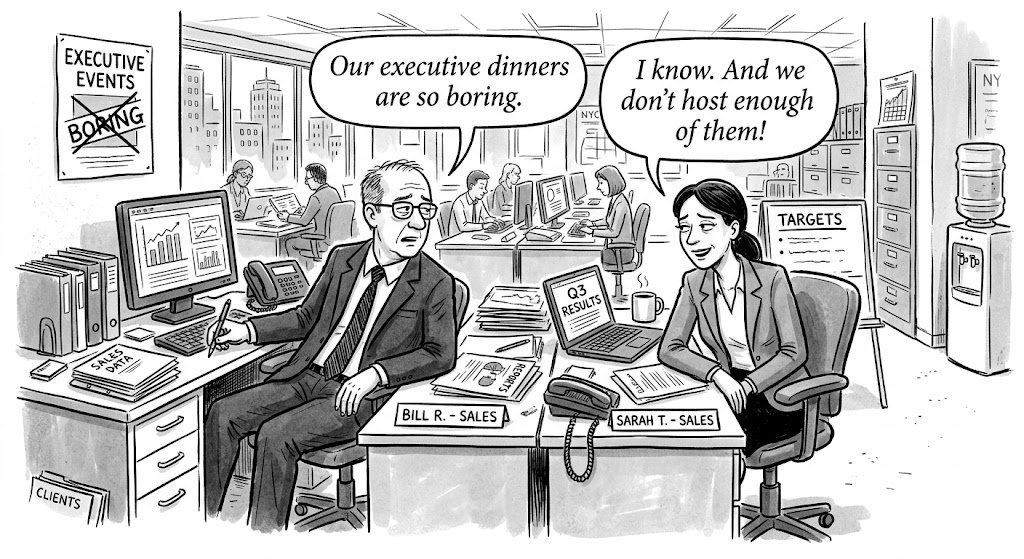
It could be that they're lazy.
It could be that they don’t even know the dinner is happening.
It could be that they genuinely don’t think it’s worth their prospect’s precious time.
Or—most likely—it’s a toxic, multi-course cocktail of all the above.
We’ve all seen the standard executive dinner playbook go wrong:
Marketing books a steakhouse and recycles a 30-slide webinar deck.
Sales, assuming the evening will be a snooze-fest, sends out two half-hearted invite emails.
The room ends up half-empty, marketing cancels the series for “low ROI,” and then sales have the nerve to ask, “Hey, why aren’t we doing dinners anymore?”
If you want to stop hosting hostage situations and start driving revenue, you need to treat your dinner series like a strategy, not an event.
Selling the Sellers: The Internal Enablement
You cannot just drop a dinner on the marketing calendar and post a message in #sales-announcements. You have to sell the sellers.
Most BDRs have never stepped foot in an executive dinner; they treat it like a 15-minute Zoom demo. Invest 15-20 minutes in a dedicated prep call to walk them through the "why," the ideal guest profile, and the narrative.
For your AEs, you need to answer the only question they actually care about: Why should I prioritize this over cold-calling, and how do I pitch it so my prospect gives up a Thursday night with their family?
And let’s be blunt: Executive dinners require a phone call. Use email to build recognition, but use the phone for the hand-sell. A prospect needs to hear genuine excitement from an AE extending a scarce, high-value invitation. Spray-and-pray email blasts devalue your brand before the appetizer even hits the table.
The 5-Part Selling Menu
When you arm your team with these five pillars, you stop begging for seats and start managing a waiting list.
1. The restaurant is a signal
Don’t just give Sales a venue name; give them a story. Why was this restaurant picked? Does it have a Michelin star or two? A signature dish? Is it impossible to get into? (Hint: if the answer is, “it’s the first steakhouse that popped up in Google,” you’re doing it wrong.) You don’t need to belabor it, but the restaurant itself should be part of the sales pitch, both to prospects and your own sales team.
2. The experience
A free meal and a hard-sell are a cliché that resembles timeshares more than enterprise software. Good food and wine are table stakes. What are you doing to make this dinner different? If you don’t have a good answer, you need to start over. You need to think about the experience you want to stage first and then figure out how to bake that into the dinner. My rule of thumb: if the deck makes sense outside that private dining room, you’ve missed the point. Whether you’re using custom menus or surprise interactive elements, build a narrative that is inseparable from the room and then convey that to your sellers so they know this isn’t an ordinary executive dinner.
3. Real executive presence
If you’re spending tens of thousands of dollars on a dinner series, you need to spend a little extra to seed the room with senior leadership. Sending two commission-sweaty AEs as your sole company presence sends an immediate message to the room: You are the leads, and these are the sharks. If you don’t have local senior execs, fly one or two in. If it’s a room of 12-20 prospects, it’s absolutely worth it. (P.S. Sales leadership is different; allowed, if not recommended!)
4. Peer-to-peer networking
As proud of your pitch as you may be, an important draw for most executives is the other people in the room. The tighter you hold the line on attendee titles, the easier the dinner is to sell. CISOs want to meet CISOs. Broadening titles should be your absolute last resort to fill the room.
5. True scarcity
Your sales team needs to frame this as a golden ticket. There are millions of people in a city, and only 15 to 20 seats at your table. This isn't an open-enrollment webinar; it’s a rare, curated invitation. The larger your sales team, the easier this should be. If you have 100 salespeople and 20 seats at a dinner, you want to prioritize by expected pipeline, which likely means starting with the segment with the biggest companies (Strategic, Enterprise, whatever your company calls it) and giving them a week to fill as many seats as they can before opening it up to smaller companies. If you told the Strategic sellers that they get just two seats at the dinner, they will pick their best prospects and they’ll do what they can to get them there. If you open it up to all segments at the same time, you run the risk of having a room full of prospects from small accounts that aren’t going to get you to your pipeline goals. A seat should not just be scarce to your prospect, it should also be scarce to your sellers.
The Result
When you get this right, you stop begging Sales to fill seats. They’ll do it eagerly—because their prospects will text them the next morning to say thank you. It opens locked doors, accelerates pipeline, and transforms a line-item expense into a revenue engine.
If your field dinner strategy currently looks like a cold presentation paired with rubbery chicken, it’s time for a change. Let’s talk, and turn your next series into an experience your prospects—and your sales team—will actually remember.