How Kim Kardashian taught me sabrage
It’s 2006, an hour until sunset. I’m standing in a dimly lit parking garage armed with six bottles of cheap, room-temperature bubbly and a sword.
In 60 minutes, I have to stand at a high-end magazine launch party and demonstrate "the ultimate luxury holiday gift" for the man who has everything: a Champagne saber.
Minor detail: I’ve sold dozens of them on my e-commerce site, but I’ve never actually sabered a bottle in my life.
I line up my first shot. I swing.
Chip. A sliver of glass flakes off. The cork stays stubbornly sealed.
Second bottle? Nada.
Third bottle? A glass-chipped tragedy.
The party was going to start soon, and I resigned myself to talking about what a great gift a Champagne saber is but having no idea how to properly use one.
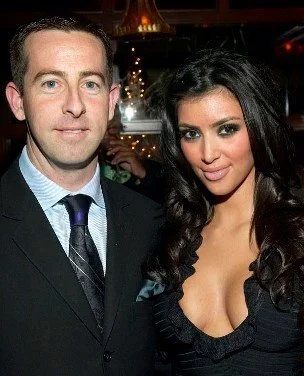
Yes, that photo at right is real. From 2006.
The next morning, I Googled “how to saber Champagne.” Keep in mind, this is 2006. YouTube exists, but it’s not yet the site where you can find multiple videos teaching you how to do anything you can imagine.
Over the course of the last decade, I estimate that I have personally taught over 100 people how to saber Champagne. The number jumps to 400+ if I count everyone that has seen and heard me teach, but if we just count the number that physically sabered a bottle at the end of my lesson, it’s over 100. I take great pleasure in teaching it because it’s a cool party trick that is much easier to do than it looks, provided you know what to do. Rather than teach you how to saber Champagne here, I’m going to teach you how to teach someone else to saber Champagne.
Prep
For this exercise, you will need:
A Champagne saber (or something similar, a Chef’s knife, doesn’t have to be sharp but needs a blunt edge)
A bottle of Champagne
An ice bucket filled with ice and water
(Optional) a baseball display case
I start every lesson with two pieces of preparation advice:
The bottle has to be cold! The colder the better. I recommend putting the bottle into an ice bath at least 15 minutes before you plan to open it; I’ve found it’s diminishing returns after that. If you can, get the whole bottle iced, even if it means gently laying it upside down so the neck of the bottle gets some time in the ice water. My 2006 parking garage catastrophe? Purely a temperature failure.
Don’t buy the cheapest bottle you can find. When you’re learning, it’s tempting to think, “I’m just practicing, a $6 bottle of Brut is fine.” It almost certainly is not. Cheap Champagne or sparkling wine is bottled in cheap glass which tends to break dangerously when sabered. If you’ve seen the blooper-like videos where someone sabers Champagne and the bottle explodes, that was almost certainly a cheap bottle. You don’t need to practice with Veuve Cliquot, but I highly recommend buying a $25+ bottle.
So, to properly prepare, have a decent bottle of Champagne, an ice bath, and 15 minutes until showtime and you’ll be ready to go.
Technique
Once you have your volunteer, an ice cold bottle, and something to saber with, you want to talk them through what’s going to happen. Because there is so much pressure in the bottle, once you remove the cage from the top, the clock starts ticking and you (or they) have less than 30 seconds before the cork will fly out on its own. So, I talk them through the steps before we remove the cage.
Find the seam of the bottle. There’s usually two seams that run up the entire bottle on opposite sides of the bottle; you (or they) just need to find one of them. If you can’t find it, angle the bottle in the light and instruct the volunteer to remember where it is. Often, the easiest way to do that is to point to something visual on the label (e.g. “remember, the seam runs up from the letter ‘o’ on the label”). I explain that the weakest part of the bottle is where the seam meets the neck, and that’s why we’re going to run the saber up the seam of the bottle.
I show them that the saber is going to be driven up the seam flat against the bottle. We’re not “chopping” the top off the bottle; the blunt edge of the saber will hit the ice cold lip of the bottle and the air pressure will do the rest. The saber will be flush with the bottle.
For strength, I explain it’s like a “half-swing” in golf or tennis. They need to be firm, but it doesn’t require all of one’s strength. Brisk and firm, following through all the way will get the job done.
Then, because some Champagne is going to spill out of the bottle, they should hold the bottle in their non-dominant hand at a 45-degree angle out over their shoes to avoid spillage.
With the saber in their dominant hand, I tell them that I am going to remove the foil and cage from the top of the bottle, and then I’ll count them down. At this point, make sure no one is in front of the saberer—that is incredibly dangerous. Onlookers should be behind or to the side of the saberer.
Remove the foil and cage for them, count down 3, 2, 1…and 19 times out of 20, it’ll be a huge success! (You do need to be prepared to jump in in case it’s the one out of 20 times it doesn’t work.)
Safety first
When guests first see the saber, someone almost always makes a remark about danger. After all, it does look like a sword, of sorts. But most sabers are not sharp; you need a blunt edge to do it successfully, not something razor sharp. In reality, the thing most likely to get someone hurt is the glass at the top of the bottle and the glass still attached to the cork after it's been sabered. That glass has been cut and it is extremely sharp. If you are sabering at a restaurant with service staff that has never seen sabering before, make sure they are aware that when it comes time to pour a toast, that they need to avoid grabbing near the top of the bottle.
Similarly, the cork is going to fly away with some sharp glass still attached to it. That glass is also sharp. I make it a point to personally grab the cork and glass before anyone else tries out of fear they will grab it without realizing it can cut them if they are not careful. I suggest you do the same. I also have another reason I grab the cork…
Coup de grâce
Assuming the person you’re teaching has never sabered before, they are going to be excited when they’re done. They’ll have a little adrenaline rush. Hopefully someone took photos or recorded a video for posterity. I like to take it one step further by giving them a souvenir with which to remember the accomplishment.
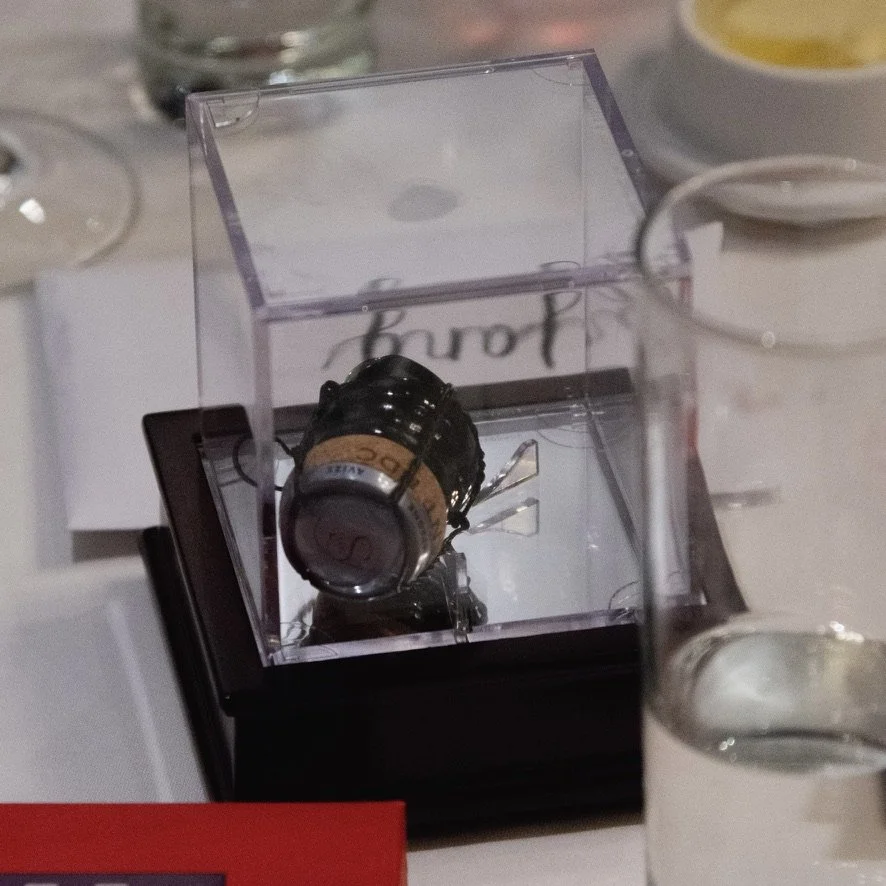
Because my dinners are planned in advance, I purchase a baseball display case for each volunteer I expect to have (for a dinner of 20 people, we usually saber two bottles of Champagne so each guest gets a couple ounces for the toast). I also buy a little engraved plate that adheres to the case that has the name of the event and the date.
I keep the display cases hidden until the pop and flourish are over. When guests return to their seats, their custom souvenir awaits—a permanent trophy of an unforgettable evening.
Want to turn your next executive dinner into an unforgettable experience?
From orchestrating flawless room dynamics to teaching your key prospects how to safely slice open a bottle of bubbly, I build field marketing experiences that seal the deal. Let’s talk strategy.