The time I learned calligraphy
Modern calligraphy, to be exact—traditional calligraphers would have my head if I weren't specific.
After the first couple of 6sensory Suppers for marketing leaders, we realized we wanted to do assigned seating so we could place guests where we wanted them. At 6sense, we had three different go-to-market segments —Commercial, Enterprise, and Strategic accounts —and depending on which executives sat for the dinner, we wanted to seat prospects strategically.
The initial suggestion? Standard printed tent cards. Absolutely not. You don't host a bespoke executive dinner only to slap down cardstock from OfficeMax. There had to be a more lavish—and absurdly expensive—way to set the table.
$400-a-Plate? In this economy?
At the same time, it was early 2023. The macro-environment had started to turn a couple of quarters before and 6sense had just done a round of layoffs a few months earlier. And here I was, proposing to gallivant across the country hosting $400-a-plate dinners while macro tech budgets were burning.
50 Hours to 5th Grade Ink
The solution was simple: I would have to learn calligraphy. You’ve no doubt heard the cliche about how it takes 10,000 hours to master a skill. I did not have 10,000 hours to spend on calligraphy. But I signed up for an online course, printed out all the worksheets, and I estimate I spent a good 50 hours teaching myself the alphabet in upper- and lower-case. The cards weren’t pretty, but they weren’t ugly. All I needed was a way to explain why such an amateur calligrapher would have made their cards.
Back to the economy. I’d open every Supper with some housekeeping: directions to the restroom, a word about pacing their alcohol consumption due to a few drinks being integrated into the dinner’s content, and then some words to assuage their guilt about indulging in such an expensive meal while the economy was so precarious. I looked in the mirror, I told the audience, and looked for areas I could mitigate the expense of the dinner. For example, the Champagne we sabered was almost always non-vintage; very good, $100/bottle Champagne in most cases, but not from a specific vintage. The dessert wine served later would be a humble 1977 vintage—even if my palate quietly wept for a 1970.
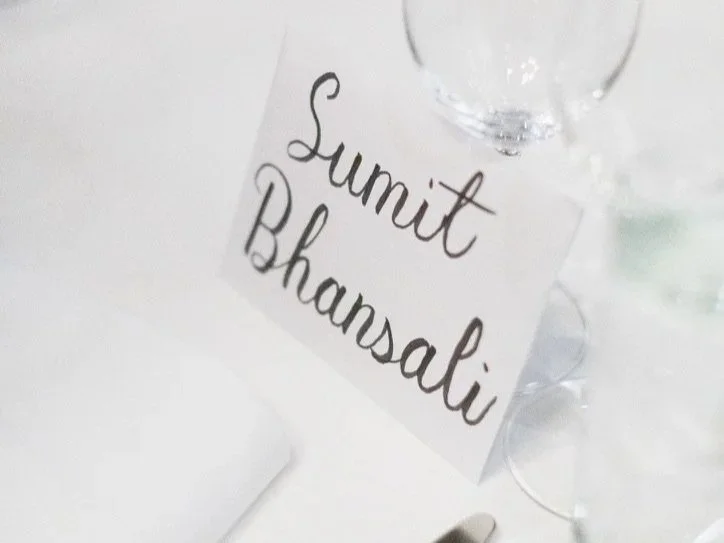
“And finally, I wanted to hire a professional calligrapher to hand draw your place cards, but that too was a victim of the current economic situation. So I took an online course in calligraphy and hand wrote your place cards myself, in case you’re wondering why they look like the nice handwriting of a 5th grader.”
In hindsight, I believe the company made the right decision that, if there were high-value prospects willing to spend 2 ½ intimate hours learning about 6sense, it was well worth the expense. The result? A room full of relaxed, laughing executives—and a pipeline ROI that made every cramped, ink-stained minute worth it.