But first, the table stakes
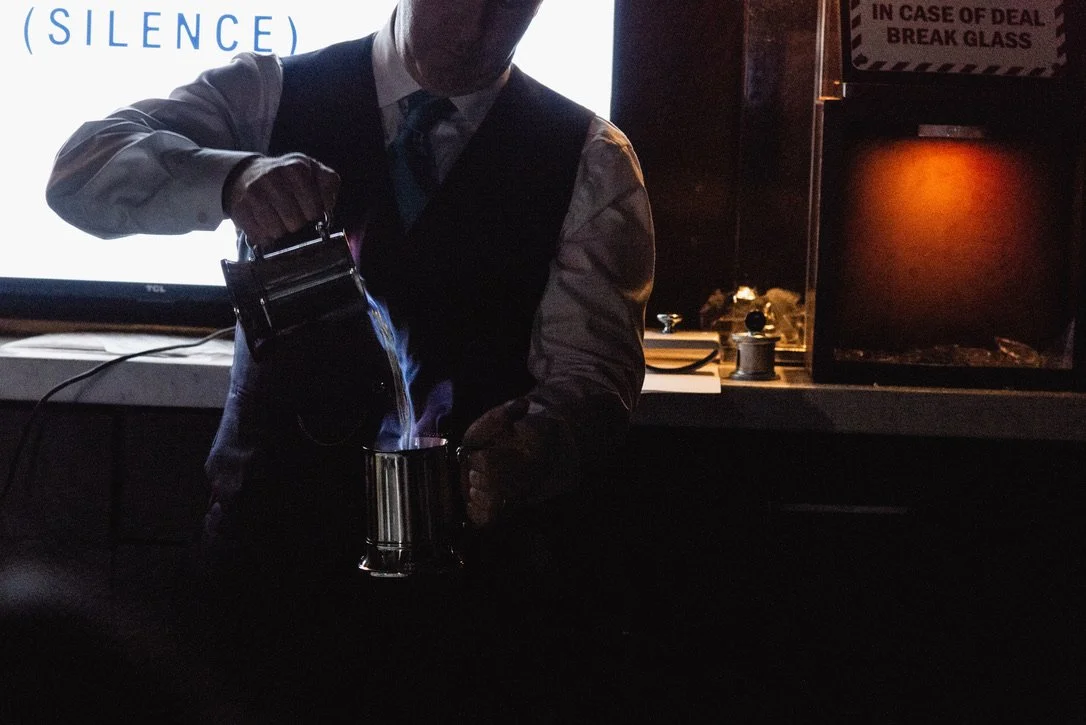
I'm not saying you must risk second degree burns for your dinner to be a success, but I'm not not saying that!
Most executive dinners are a steakhouse, a slide deck, and an AE who asks qualifying questions between courses. Executives have seen this movie. They're not coming, and if they do, they're not remembering you.
Over the past six years, I have performed more than 30 executive dinners about four completely different concepts for four different personas at three companies: Microsoft (CRM), 6sense (ABM), and Parloa (Agentic CX). Those dinners have generated new pipeline, converted skeptics, and confirmed prospects' decisions to buy. I’ve won awards, received job offers, and — in one memorable evening — had a restaurant manager physically intervene to stop me from setting things on fire, sabering Champagne, and performing a Victorian-era port ritual. (All three. Same night. Toronto.)
Note: This is about presentation-style dinners — not the networking or community dinners, which are a different animal entirely and not my area of expertise.
What if we were to charge admission?
Please, don’t actually do it. But "What would we do differently if we were to charge admission?" is my favorite question to ask about any experience.[1]
Since, in the history of executive dinners, guests have not had to pay to watch a company pitch over dinner, that is the floor. If you had the chutzpah to charge, you'd have to offer more than that. What could that mean? That's up to your imagination, but for starters, it could include food or beverages that are extraordinary, and that a guest wouldn't necessarily expect to be free (think caviar, truffles, cult wine, etc.). Maybe it includes your product, or an extended trial of your product beyond a 30-day free trial. Maybe there are souvenirs or gifts special enough that a guest would pay to attend. When you think about what it would take to get someone to pay to attend, you raise the stakes to provide the kind of experience that leaves an impression.
This led to the second insight:
Make the dinner itself a draw
Too often, event managers are looking for an upscale restaurant that fits into a budget of $150/person, plus or minus 10%. A city's best steakhouse is a common venue. The problem with this approach is that, while the restaurant may be new to you, the field marketer based elsewhere, it's old hat to the senior executives that live there who have eaten at that restaurant dozens of times already. Presumably, you're hosting these dinners in big cities that have lots of high-end restaurants. By being willing to spend 20-30% more, you can book one of the nicest or hottest restaurants in town where your target personas are eager to dine.
There is a never-ending supply of midlevel managers with no budget authority that can fill up your steakhouse dinner. If you want the VPs and CXOs to come, you need to be willing to pay a little more for a restaurant that itself is a draw. If you're talking about a dinner for 20-30 people, is it not worth a couple grand to attract the best group possible?
When — not if — you host the dinner at an exceptional restaurant, make sure some aspect of the food and beverage program is highlighted during the evening. For alliterative reasons, the dinner for my current employer is called "Parloa's Pitch-Perfect Perfect Pitch featuring Parker Perfects." Serious wine drinkers will immediately know what a "Parker Perfect" is; everyone else will get a 30-second lesson about it at the beginning of the dinner. Senior executives who love wine should be drawn to the special event by that mention alone, while those who had no idea what they were walking into, wine-wise, will leave with a lifelong memory of drinking three of the best wines of their lives.
Not every senior executive is a foodie, but I can assure you everyone choosing to spend an evening at a fine dining establishment is interested in learning a little about what they're eating or drinking. The food and wine don't have to be center stage, but don't assume your guests aren't interested in learning something new about food or wine when in a nice restaurant.
"Interactive" has been abused
"I want this presentation to be interactive, so feel free to ask questions along the way."
Interactivity is essential, but I’m sorry to say that inviting questions, sprinkling a few canned questions, or asking for a show of hands throughout the presentation does not make it interactive.
The thing about networking-style dinners is interactivity is baked in; it's impossible for someone to leave without having actively participated. In a presentation-style dinner like I'm describing, it's all too easy to take an existing PowerPoint deck and just have someone deliver it. That is a huge miss.
When I talk about interactivity, here’s what I mean. People will be doing things during the dinner whether they like it or not (they always like it). Here are a few of the things guests have done at dinners I’ve hosted:
Learned to saber a Champagne bottle for a Champagne toast (Dinner by Dynamics, 6sensory Supper)
Used a UV flashlight to reveal secret messages in invisible ink (6sensory Supper)
Guessed scents found in wines by sniffing little vials of aromas (6sensory Supper)
Helped me "tong" a bottle of Port (Dinner by Dynamics, 6sensory Supper)
Received a rubber chicken instead of their entree, triggering the use of a Microsoft tablet and a custom app to create a Customer Service ticket that results in the proper dish getting delivered.
Tasted a Blue Blazer cocktail made of overproof whiskey & boiling water (6sensory Supper)
Rolled dice, spun a roulette wheel, or scratched lottery tickets for an exercise about odds (Sales Leader Dinner)
Prioritized accounts by moving magnets with account names and firmographic attributes around a magnetic whiteboard (Sales Leader Dinner)
Competed in a Kahoots! quiz for prizes (Sales Leader Dinner)
Personalization is table stakes (pun intended)
While personalization "at scale" is still difficult, it's easy with a few dozen guests. Sadly, that doesn't mean every executive dinner nails it.
One example that costs nothing is for the host(s) to know everyone by name before they arrive so they can be greeted by name before introducing themselves.[2] Almost everyone has a LinkedIn profile with a photo these days. Have someone create a lookbook of all the guests with names, photos, and any notes from the Sales or CS team that the executives should know. Not every person from your company needs to know every guest's name by face, but the host or a greeter should. You'd be shocked how powerful it is when a guest is greeted by name before they've said a word.
Place cards for assigned seating are another easy personalization tactic. It’s a small touch, but it enables strategic seating, so guests are where you want them to be.
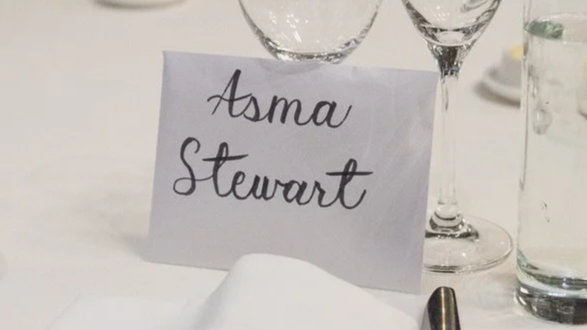
← That’s my amateur calligraphy!
The belt-tightening of 2023 led me to take an online course in modern calligraphy so that I could still have fancy place cards for guests but where it obviously wasn’t an expensive professional.
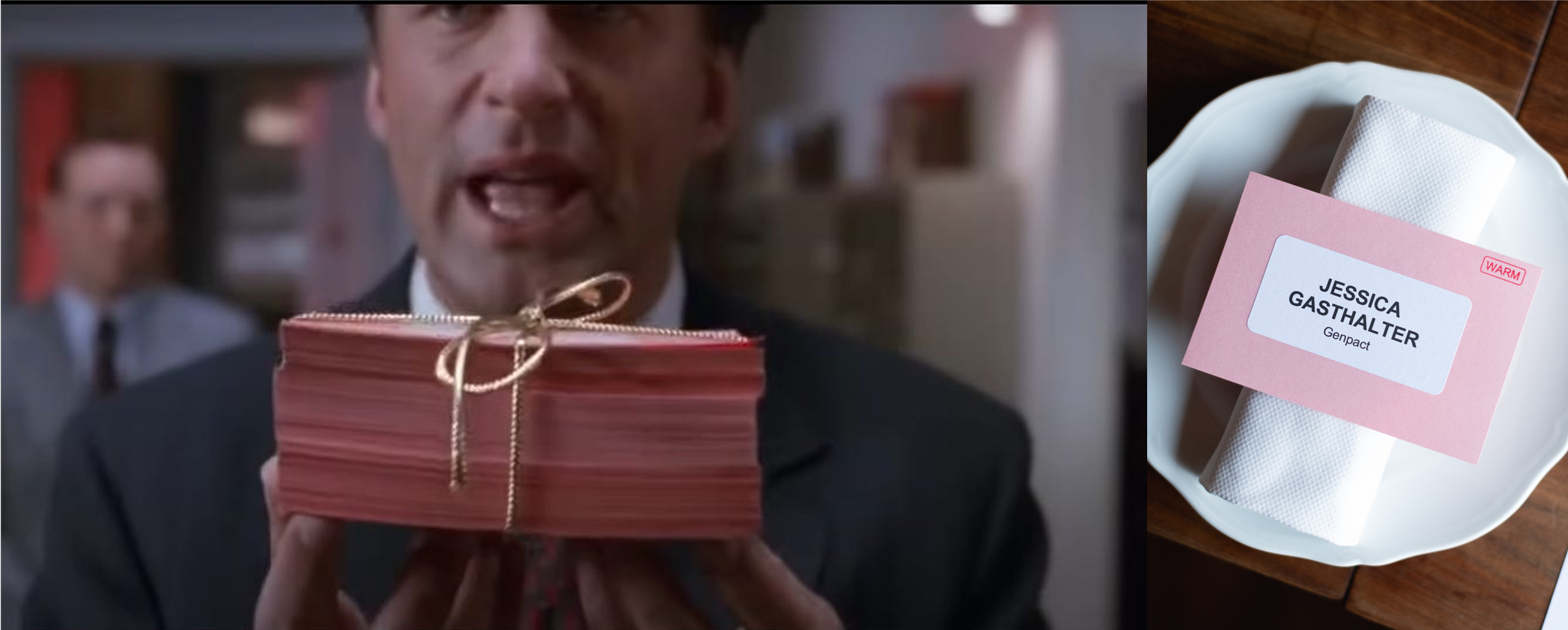
Separately, for the 6sense Sales Leader dinner, the guest's name was printed on a pink index card reminiscent of a part of the most famous sales monologue in a movie from Glengarry Glen Ross.
That’s just the start. I’ll share more extreme examples of personalization at the end of the final section.
Put the "executive" in "executive dinner"
In a dinner built for executives, it’s logical that you’d include some executives of your own. You don't have to, of course, but consider how it can contribute to the draw of the event if you can say that "The CIO, VP Product, and Global Head of Customer Success will be in attendance." It sounds 100x better than "You will be seated next to a commission-sweaty account executive from our team who will be asking you qualifying questions during every lull."
Executives want to meet, and speak to, other executives, not to salespeople. If you need to fill in a spot with an AE who lives locally, go for it. But try to bring in a couple senior executives from your company to keep the conversation flowing and to answer questions that come up during the dinner.
It's also easy to think that these dinners should be 100% prospects in attendance to maximize pipeline generated. But having a loyal customer or two in the audience, whom you may not have anything to sell at the time, can be even more powerful than having one of your own executives.
The importance of souvenirs
The dinner may end up a magical experience without tchotchkes: good food + good company = a winning formula. But a thoughtful souvenir can make the memory of the evening — and thereby, your company — last even longer. Company swag will do in a pinch, but that’s hardly what I’d call "thoughtful." Is there something small they could take away to memorialize the dinner?
The marketing executive dinner, 6sensory Supper, sends guests home with a cornucopia of souvenirs. Everyone goes home with a UV flashlight and a Wine Aromas 6 Scent Kit. In addition, the two guests who sabered Champagne take home a display case with the cork from the bottle they opened. Two more guests take home a proper hot toddy glass if they partook in the flaming cocktail finale. At some dinners, we've also given away a free copy of the CMO's book, No Spam. No Forms. No Cold Calls.
The sales executive dinner souvenirs revolve around an 8-minute movie clip that just about every sales leader has seen dozens of times: Alec Baldwin's monologue in Glengarry Glen Ross(censored version). To the uninitiated: "Coffee's for closers," "second prize is a set of steak knives," "Always Be Closing," all come from that one monologue.
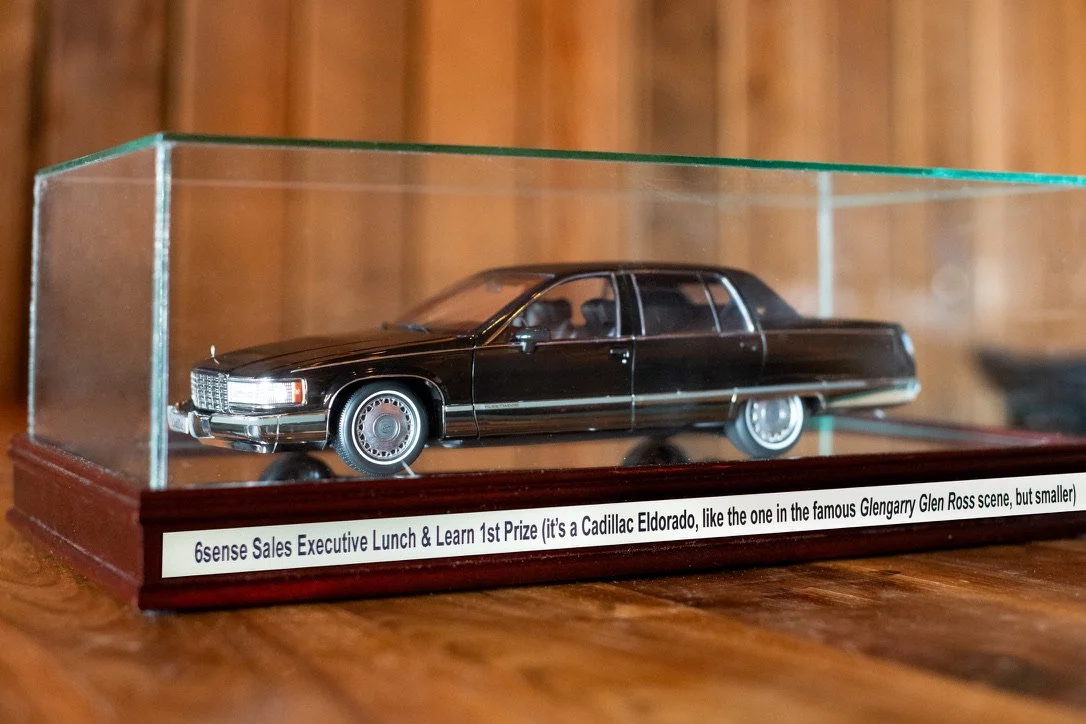
The dinner ends with a contest. First prize is a Cadillac Eldorado — specifically, a die-cast model of the black Cadillac pictured on the poster hanging in the office behind Alec Baldwin during his "motivational" monologue. If you know the scene, you already smiled. If you don't, go watch it now.
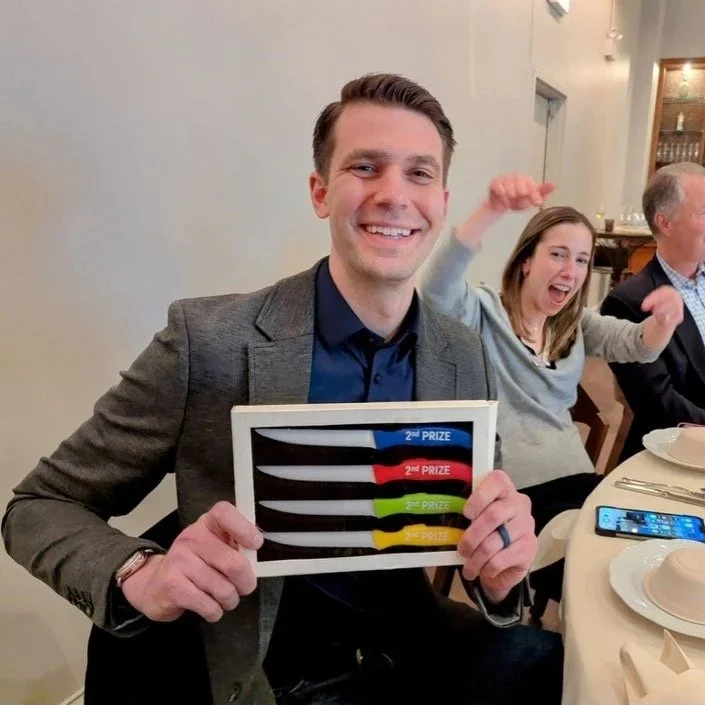
Second prize, naturally, is a set of steak knives (each labeled “2nd prize”).
And just like in the movie, third prize is "you're fired." Each guest lifts a bowl from their dessert plate to reveal a chocolate-covered graham cracker topped with a marshmallow printed with their own LinkedIn profile photo in edible ink. My team and I then circle the room with creme brûlée torches and literally “fire” everyone. Phones come out to record it immediately.
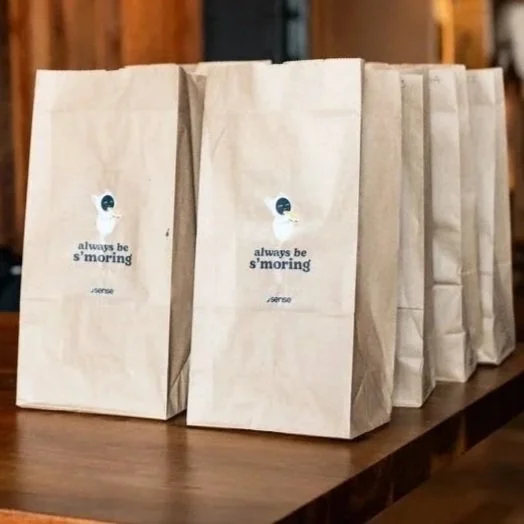
It would be a shame if only one personalized marshmallow was ever made of each guest, so we have a few extra made, bag them up with a few chocolate-covered graham crackers, and give them a goodie bag to take home so their family, friends, or co-workers can also enjoy firing them (with a final Glengarry Glen Ross reference on the goodie bag).
As one attendee wrote to me after the dinner:
“The attention to detail was end to end. The Glengarry Glen Ross-inspired “fired” marshmallows with our faces on them may be one of the greatest event touches I’ve ever seen (my kids were so mind-blown, they took them to school to show their friends!!). That was the cherry on top of an already unforgettable evening.”
The Last Unfair Advantage
Everything in marketing and sales was already becoming more digital before AI made everyone want to do even more digitally, faster, and with fewer humans involved. Ironically, that's exactly why in-person experiences have become more valuable, not less. Most marketers already know this. The conversation about the growing importance of live events is everywhere right now. I don't think it needs to be belabored; I just think it needs to be said plainly: there is no AI campaign that can replicate what happens when people are in a room together, paying attention, and sharing a genuinely remarkable experience. That's not a criticism of AI. It's just physics.
But showing up in person isn't enough on its own. An executive dinner that consists of a steakhouse, a slide deck, and a salesperson working the table between courses is a waste of everyone's evening, including yours.
When you treat an executive dinner as an experience, something interesting happens: a single evening can engage a cold prospect who's never responded to your emails, accelerate a deal already in motion, solidify one that's almost closed, and remind a customer why they chose you in the first place. Sometimes all at the same table.
No other tactic in your arsenal does all of that. The only question is how seriously you take it.
[1] Thanks, Joseph Pine and James Gilmore for planting this question in my brain via your stellar book, The Experience Economy.
[2] Will Guidara used this tactic at Eleven Madison Park, the world’s No. 1 restaurant in 2017. He documented it in his amazing book Unreasonable Hospitality.