Frame 1: Product guides the dinner
In this approach, your company's solution(s) takes center stage in the dinner. But instead of a generic, canned demo, your product will be used to move the dinner forward. For example, maybe two of the most famous business processes addressed by software were ERP's "Lead to Cash" and "Procure to Pay." Both of those processes would be perfect to guide a dinner from start to finish. From inviting a guest (Lead) all the way to "closing" them on dessert (Cash). Or, from choosing between the soup or salad (Procure) to the final bill (Pay). This was the approach I took with Dinner by Dynamics, a multi-course dinner featuring Microsoft Dynamics CRM.
You don't need to be intimately familiar with Microsoft's CRM offering to follow along. Just know that there are solutions for marketing automation, sales force automation, customer service, and field service. We used Microsoft's marketing solution to drive attendance, and we opened the dinner by showing them the Journey we created, the lists we uploaded, the emails we sent, the landing page we created, and more. Guests weren't seeing a hypothetical campaign, or a real campaign about an irrelevant company; they were seeing how they were put into a journey, where they were in the journey as of the start of the dinner, and some foreshadowing about where they would go next in the journey. Spoiler: people are a lot more attentive to a demo when it's about them!
The sales solution was used to "sell" the group on wines or desserts, depending on the restaurant. The customer service solution was used to fix an issue with a guest's entree (photo below). The field service solution was used to find someone who could tong a bottle of vintage Port since the sommelier was busy.
All of these "issues" were set up in advance, of course, for the software to be the hero of the evening. Technically, guests were seeing a "demo" of the solutions, but it was compelling because it was entertaining, educational, and directly affected each guest.
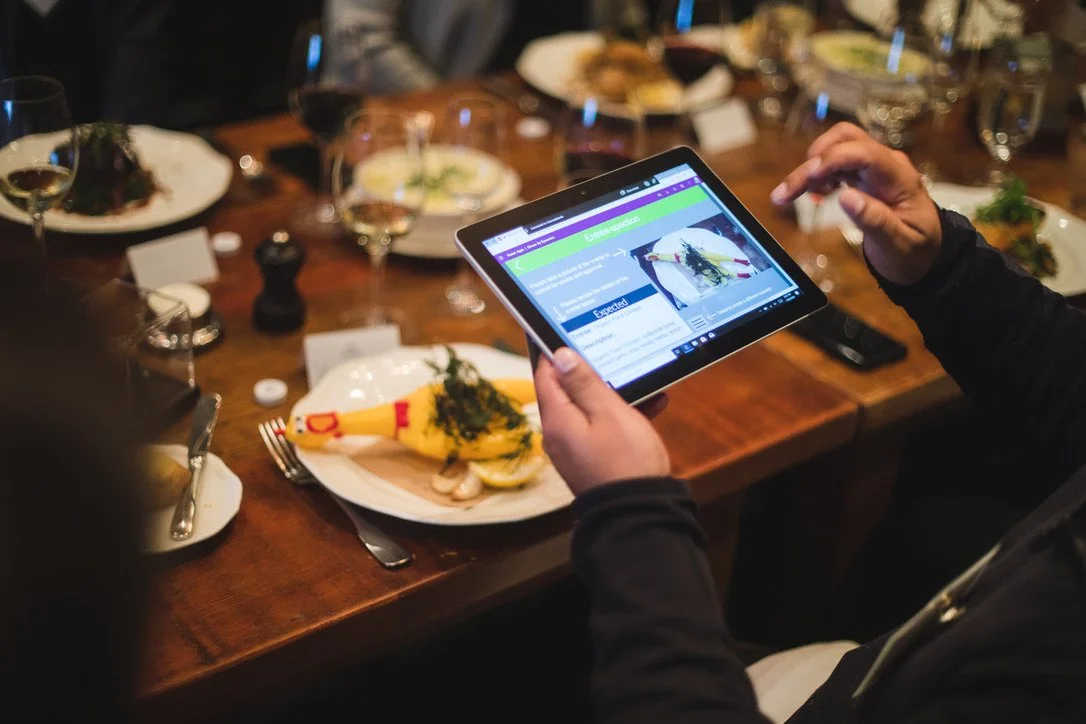
At left, a Microsoft Surface Tablet is running a custom Microsoft Power App integrated to the Microsoft Dynamics Customer Service instance we’re using to orchestrate the dinner. In this case, it creates a customer service case in real-time to help a guest with their incorrect entrée.
In my latest dinner for Parloa, a voice-first, agentic, customer service solution, I built a custom AI agent to co-host portions of the dinner. Guests hear the agent do its thing and then get a backstage look at how the agent was designed. The agent is woven into the entire evening, from "authenticating" guests as they introduce themselves, all the way through rating the dinner itself at its conclusion (I won't spoil it, but it's cleverer than your typical Likert scale).
You may be thinking "my company's solutions don't have anything to do with a dinner!" I would contend you're not being imaginative enough. Dinners involve all sorts of different things: people (HR solutions), cost of labor and goods (finance solutions), promoting the event or capturing demand (marketing), sales, customer service, security (since it's in a private dining room), logistics … I could go on. The key is you can pretend.
Even if dinner attendees aren’t users of your product or service, you can help them imagine they were for the purpose of the dinner.
CFOs who are well beyond bookkeeping? The chef has a COGS spreadsheet for every dish, and the sommelier can get you the same for every bottle. Your audience would eat up (ahem) a granular lesson in restaurant economics.
Negotiate everything with the restaurant in real time — price per head, room charge, AV fee, gratuity. You’d need them in on it ahead of time, but that’s not hard.
For the HR leaders: recruit a standout server on the spot, role-play an interview, then stage a faux promotion. Hand them a $100 bill, a nameplate, and tell them they’ll now have more work for the same pay. Employees love that!
Make attendees the data. In Dinner by Dynamics, each guest was a live customer record in a CRM instance built for the dinner, and their journey was tracked from invite to dessert across marketing, sales, customer service, and field service.
This approach offers several benefits. For one, it ensures interactivity if the product is being used in service of the dinner. Second, it's safe to assume that an executive willing to sacrifice personal time to attend a dinner pitch is aware they have a problem. They're aware you may have a solution. Here, guests get to see real product. How does it look? Do I think my team could use it? Does it do what they say it does? Sure, the use case is nonsensical, but it answers a lot of other questions they already had about your offering.
You're creating an experience; the dinner is just part of it. Don't let the real world constrain your imagination in terms of what you want your guests to take away from the evening. If you've read this far and you're struggling to think about how your solution(s) can be used in a dinner, contact me and I'll help with ideas free of charge. Seriously, that's how much I love it.