How to tong vintage Port
Does anyone actually order Port? Left to their own devices at an open bar, almost never. But turn it into a high-stakes, fire-and-ice ritual at the end of an executive dinner, and your guests will be talking about your brand until the next fiscal year.
There are lots of reasons Port is not particularly popular, but the main one is that most people have not tried really good Port. Young Port is almost always really sweet, sometimes very syrupy, it’s easy not to like. But vintage Port. That’s a different animal. These days, if you can get a bottle from the great vintages like 1994, 1985, 1977, or 1970, you’ll be treating your guests to a special treat, one they would never try otherwise. This is one of the reasons I like to offer a vintage bottle of Port as a dessert wine in some of my dinners.
The other reason I include Port, of course, is that “Port tonging” is pretty cool. So why bring fire to a fine dining table? Decades of aging soften vintage corks into fragile, crumbly sponges. Traditional corkscrews usually result in a cork disintegrated inside a $300 bottle. Port tonging bypasses the cork entirely by cleanly snapping the glass neck below it.
How does it work? Thermal shock! Thermal shock occurs when there is a sudden shift in temperature that causes glass to fracture in a precise location. Port tonging, then, uses iron tongs to heat the neck of the bottle just below the cork until it’s scalding hot, and then applying something freezing cold to that same area, causing the glass to break cleanly.
Prep
For this exercise, you will need:
The Tools: Port tongs, camp stove + fuel, lighter.
The Thermal Shock: Shave brush (or feather) + ice bath.
The Service: Vintage Port (1985 or older), decanter, cheesecloth.
The Keepsake: Wax pellets & butter warmer (optional, but highly recommended).
Technique
The first time I did this, I was terrified I’d explode a rare 1977 Dow’s in front of a room full of C-suite executives. Spoiler: physics works, and you look like a wizard.
Before you do anything, fill your bowl or cup with ice water and soak whatever instrument you’ll use to activate the thermal shock. The heating part only takes a few minutes, so start icing down the shave brush or feather while you set everything else up.
Then, remove any of the paper or label that might be at the top of the neck of the bottle. You want the heat from the tongs on the glass, not impeded by a label.
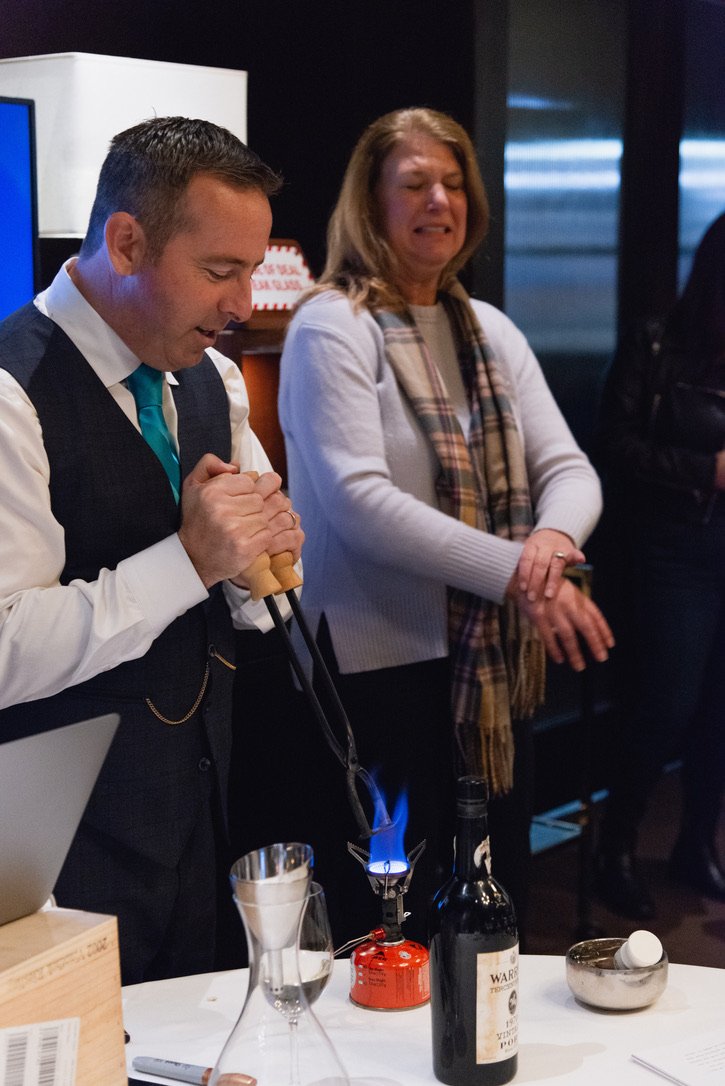
Attach your camp stove onto your fuel source and turn on the gas as high as it goes. A match or a lighter is plenty to ignite it.
Hold the iron tongs close to the flame and heat them until they turn red. They will turn red. Depending on the heat of the flame, sometimes it can be as fast as a minute, sometimes it might take 2-3 minutes. But heat them until they are red.
Once the tongs are red, turn off the stove, open the tongs so they fit over the top of the bottle, and close them around the neck, trying to ensure they are below the bottom of the cork (i.e. don’t apply the tongs at the very top of the neck, go as far as you can while still surrounding the entire neck). Hold tight for about 30 seconds.
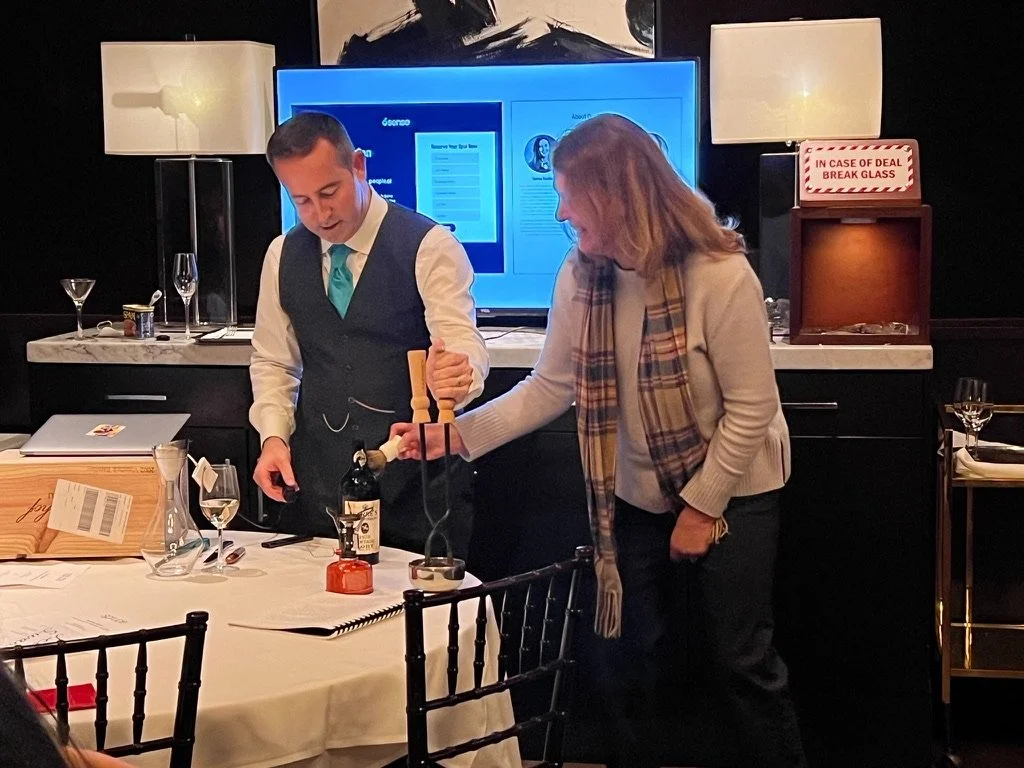
Applying the ice cold shave brush to the neck of the bottle to cause thermal shock
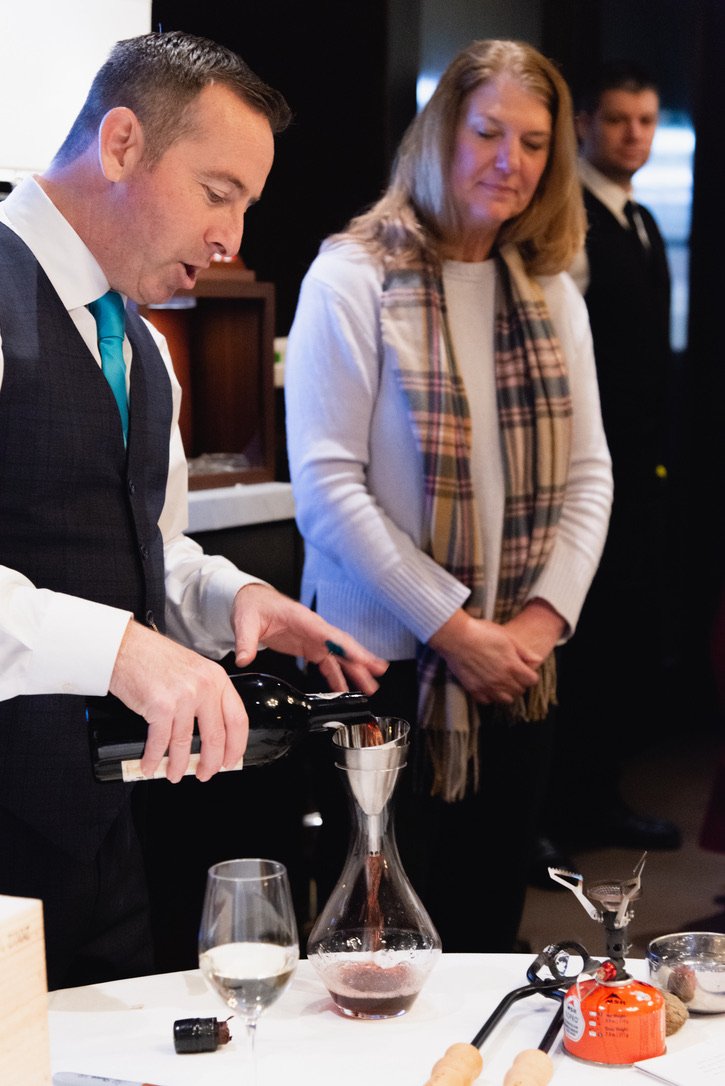
Remove the tongs from the neck of the bottle, and set them somewhere safe (they are still very hot!). Since I usually have a volunteer next to me to do the ice part, once they pull out the shave brush, I like to set the tongs into the ice bath so the tongs cool down quickly. You, or a helper, can lightly swipe the shaving brush or feather around the entire neck of the bottle where the tongs were seconds before. If done right, you’ll hear a little ping as the glass has cracked. Congratulations! You’ve done it.
The top of the bottle rarely falls off, the fracture is enough that you can gently take the top of the bottle off, although I recommend doing it with a napkin so you aren’t touching the glass directly. The top should just fall off easily, below the cork.
Since the point of tonging Port is to avoid the cork being pushed into the bottle, it really only makes sense with an old bottle of Port, I’d say 1985 or earlier (1977, 1970, 1963 other famous vintages). Assuming your Port is 30+ years old, there is likely sediment that has built up in the bottom of the bottle. You should decant the Port, ideally by first pouring it through a funnel or through cheese cloth to catch the sediment.
Coup de grâce
Admittedly, I stole this idea from Eleven Madison Park back in their glory days which you can see in the video below. Essentially, they create a wax seal for both the top of the empty bottle as well as the bottom of the cork + bottle top. To do this, melt some wax pellets in a small saucepan or butter warmer, make sure the bottle is completely empty of Port, and then dip it into the melted wax so that it creates a wax seal on the top of the bottle. Repeat for the top part of the bottle. It looks cool, and it makes both souvenirs safe! The glass, after all, is extremely sharp where it was fractured.